
The Cast
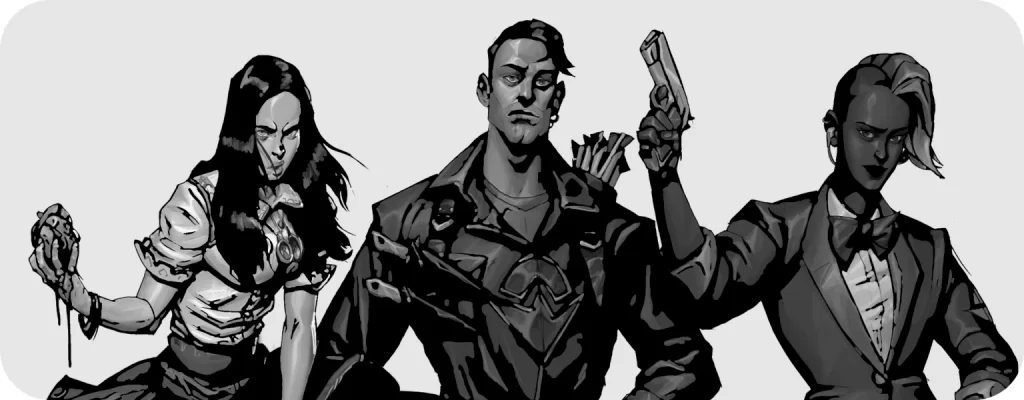
This page is for players.
As a player, it’s your job to survive whatever Threat the Director has planned for you. If you’re lucky, you’ll be able to investigate the Threat, unravel its weaknesses, and dispatch it for good. If you’re unlucky… the story won’t end well for you.
Your character is synonymous with your character sheet. It lists your Actions, traits, motives, fears, and so on. When you are injured, you rip off part of your character sheet. When you gain a level, you unlock new sections of your character sheet.
You have two ways to make a character: Archetype Characters and Advanced Characters. You can make an archetype character in minutes—it has everything you need printed on the character sheet and offers plenty of ways you can make the character your own. By contrast, an advanced character offers more freedom of expression, but requires more time and creativity on your part. Try archetype characters for your first game, especially if you’re new to roleplaying games.
Character Sheets
| Modern Archetypes | Medieval Archetypes | Futuristic Archetypes |
| Agent | Alchemist | Amnesiac |
| Antiquarian | Dungeoneer | Gadgeteer |
| Con | Graverobber | Hacker |
| Exorcist | Inquisitor | Merc |
| Final Teen | Magician | Private Eye |
| Financier | Mystic | Smuggler |
| Ghost Hunter | Scoundrel | |
| Prodigy |
Archetype Characters
You can make an archetype character in under five minutes; just print a character sheet and follow the instructions on the sheet.
Character Creation in Ten Steps
Here’s an overview of how you create a character:
1. Pick an Archetype. Your archetype is the core expression of your character, an homage to existing horror characters that you use as a starting point. Your archetype determines which character sheet you use.
2. Pick a Personality. Sum up your personality in a word or two. This is a broad-stroke that helps to define how you see and interact with the world. If you struggle to come up with a personality, you can pick or roll from the following table.
Table: Personality
| D66 | Personality |
| 11 | Anxious |
| 12 | Articulate |
| 13 | Athletic |
| 14 | Blunt |
| 15 | Boisterous |
| 16 | Compassionate |
| 21 | Competitive |
| 22 | Courageous |
| 23 | Cowardly |
| 24 | Cunning |
| 25 | Curious |
| 26 | Cynical |
| 31 | Daring |
| 32 | Dashing |
| 33 | Decisive |
| 34 | Devout |
| 35 | Earnest |
| 36 | Earnest |
| D66 | Personality |
| 41 | Folksy |
| 42 | Impulsive |
| 43 | Insightful |
| 44 | Intrepid |
| 45 | Meticulous |
| 46 | Outspoken |
| 51 | Paranoid |
| 52 | Plucky |
| 53 | Pragmatic |
| 54 | Quirky |
| 55 | Refined |
| 56 | Sarcastic |
| 61 | Savvy |
| 62 | Self-Assured |
| 63 | Shy |
| 64 | Stoic |
| 65 | Sexy |
| 66 | Worldly |
Tip: d66 means 1d6 × 10 + 1d6
3. Pick a Quirk. Come up with something unique, funny, or special about yourself. Your quirk helps to make your character memorable and engaging. If you struggle to come up with a quirk, you can pick or roll from the following table.
Table: Quirks
| D66 | Quirk |
| 11 | Absolutely Loves Drama. |
| 12 | Believes Every Conspiracy Theory. |
| 13 | Blows Up At the Slightest Inconvenience. |
| 14 | Can’t Tell Anyone “No.” |
| 15 | Dabbles in the Occult. |
| 16 | Easily Gets Distracted—Oh Look a Bird! |
| 21 | Falls in Love At First Sight At Least Once a Day. |
| 22 | Fidgets Constantly. |
| 23 | Forgot Everything You Just Told Them. |
| 24 | Has a Heart of Gold. |
| 25 | Has an Unending Collection of Fun Facts. |
| 26 | Identifies as a Pyromaniac. |
| 31 | Insists on Being Called a “Paranormal Investigator.” |
| 32 | Insists on Doing Things the Hard Way. |
| 33 | Is Cool as Ice. |
| 34 | Is Deeply Superstitious. |
| 35 | Is Getting Too Old for This. |
| 36 | Is Having a Midlife Crisis. |
| D66 | Quirk |
| 41 | Is Probably Too Young to Be Here. |
| 42 | Is Terrified of Clowns. |
| 43 | Is Utterly Unremarkable. |
| 44 | Is a Certified Sociopath. |
| 45 | Is a Terrible Liar. |
| 46 | Lives For the Spotlight. |
| 51 | Loves Animals. |
| 52 | Never Backs Down From a Challenge. |
| 53 | Never Forgets a Face. |
| 54 | Reflexively Makes Dad Jokes. |
| 55 | Relentlessly Champions a Cause. |
| 56 | Sleeps with One Eye Open. |
| 61 | Sounds like Mickey Mouse. |
| 62 | Subscribes to Every Branch of Mysticism. |
| 63 | Swears Like a Sailor. |
| 64 | Thinks They Know Everything. |
| 65 | Won’t Go Back to Prison. |
| 66 | Won’t Stop Talking. |
Tip: d66 means 1d6 × 10 + 1d6
4. Make Your Character Sentence. Write your character sentence on your character sheet. It’ll be in the form of “I’m a [Personality] [Archetype] who [Quirks].” Now is also a great time to pick your character’s name.
5. Choose your Motive. Your motive is the thing you want or believe in most. This is what drives you on a fundamental level. You might want to “Protect your community at all costs” or “Become wealthy beyond anyone’s imaginings.”
You will also always gain Advantage if your Action is in furtherance of your motive.
If you struggle to come up with a motive, you can pick or roll from the following table.
Table: Motive
| 2D6 | Motive |
| 2 | Achieve my employer’s goal |
| 3 | Become famous |
| 4 | Find true love |
| 5 | Exact revenge on someone |
| 6 | Complete my magnum opus |
| 7 | Forestall my death or live forever |
| 8 | Make a fortune |
| 9 | Prevent my secret from being discovered |
| 10 | Protect a loved one |
| 11 | Protect and improve my community |
| 12 | Uncover a supernatural secret |
6. Choose your Fear. Your fear stands in the way of accomplishing your motive. This might be a simple phobia, such as “Clowns” or “Closed Spaces,” or an abstract idea, like “Not Knowing where I fit in” or “Becoming Irrelevant”.
The Director can force you to act in accordance with your fear, even when you don’t want to.
As a horror game, Blood on the Lens is a place to explore and conquer your fears in a safe space. If you choose a fear that affects you personally, discuss the matter with your Director and use an RPG safety system to ensure that the game remains comfortable and fun, no matter where the story takes you.
If you struggle to come up with a fear, you can pick a phobia or abstract fear or roll for one from the following tables.
Table: Phobias
| 2D6 | Phobia |
| 2 | Clowns |
| 3 | Confined Spaces |
| 4 | Corpses |
| 5 | Darkness |
| 6 | Deep bodies of water |
| 7 | Fire |
| 8 | Heights |
| 9 | Illness and disease |
| 10 | Needles or sharp objects |
| 11 | Spiders |
| 12 | Wild animals |
Table: Abstract Fears
| 2D6 | Abstract Fear |
| 2 | Becoming impoverished |
| 3 | Being forgotten |
| 4 | Being rejected by others |
| 5 | Being the center of attention |
| 6 | Confronting my guilt |
| 7 | Disappointing loved ones |
| 8 | Growing older |
| 9 | Losing control or freedom |
| 10 | Losing sanity or identity |
| 11 | Not being accepted by others |
| 12 | Professional failure |
7. Actions and Reactions. You gain +1 to any three Actions or Reactions of your choice. Fill in the dots next to selected Actions and Reactions to show that you roll additional dice when using that roll. Ideally, these rolls should be related to your other character choices.
8. Appearance and Notes. Fill out the Appearance box of your character sheet to determine what you look like to other people, what you’re usually wearing, and what you’re usually carrying with you. If anything else comes to mind, jot it down in the Notes box. Finally, pick your name and your pronouns (if you haven’t done so already).
Roleplaying games are a space to try out identities like you try on clothes. Feel free to pick pronouns that don’t match your own or explore identities that spark your curiosity. As with horror elements, it might be a good idea to use an RPG safety system to ensure that this space is as safe as possible for exploration.
9. Wrapping Up. Finally, go over every remaining box on your character sheet, filling out all those available. If a box contains a star, it unlocks at a later level. Some of these boxes will elaborate on your history, give you connections to other players, let you choose a weapon, and grant you other character choices. Sometimes you’ll have to Sacrifice a box during character creation, ripping parts off of your sheet.
10. Have Fun! Your character sheet is going to evolve with the story around you. It’s going to be scribbled on, torn up, and expanded. It might even be destroyed completely when your character has reached their bitter end. This piece of paper is your lifeline in a dangerous world, so keep it close.
Advanced Characters
Advanced characters take a little longer to build—around ten to fifteen minutes—but offer wide latitudes in the types of characters you can create. Most of the steps for building an Advanced character are the same as building an archetype character, as detailed in the following overview. Steps that differ are marked with an asterisk and detailed as follows.
All advanced characters use the Advanced Character Sheet.
Follow the steps below and touch base with the Director from time to time to ensure your character fits within the broad strokes of the story.
Advanced Character Creation Overview
Much like archetype characters, you can build advanced characters in a few easy steps:
- Pick Your Identity *
- Pick a Personality
- Pick a Quirk
- Make Your Character Sentence
- Choose Your Motive
- Choose your Fear
- Decide on Your History *
- Choose Your Connection *
- Pick Your Special Action *
- Actions and Reactions *
- Pick Your Weapons *
- Traits *
*Differs from Archetype Characters
Pick Your Identity
Advanced Characters
Your Identity is a word or two that sums up who you are as specifically as possible. You could be a ballerina, farm hand, veterinarian, podcaster, insurance salesperson, or any one of a thousand others. This choice, more than any other, should guide your other choices.
If you struggle to come up with an identity, you can pick or roll from the following tables, depending on whether the setting is modern, medieval, or futuristic.
Table: Identity (Modern)
| D66 | Identity (Modern) |
| 11 | Accountant |
| 12 | Banker |
| 13 | Bartender |
| 14 | Chef |
| 15 | College Student |
| 16 | Contractor |
| 21 | Engineer |
| 22 | Farmer |
| 23 | Felon |
| 24 | Firefighter |
| 25 | Hacker |
| 26 | Influencer |
| 31 | Journalist |
| 32 | Librarian |
| 33 | Magician |
| 34 | Mechanic |
| 35 | Medium |
| 36 | Musician |
| D66 | Identity (Modern) |
| 41 | Nurse |
| 42 | Paramedic |
| 43 | Park Ranger |
| 44 | Pilot |
| 45 | Podcaster |
| 46 | Prepper |
| 51 | Priest |
| 52 | Professor |
| 53 | Programmer |
| 54 | Retiree |
| 55 | Security Guard |
| 56 | Stand-Up Comedian |
| 61 | Teacher |
| 62 | Therapist |
| 63 | Trucker |
| 64 | Unemployed |
| 65 | Veteran |
| 66 | Writer |
Tip: d66 means 1d6 × 10 + 1d6
Table: Identity (Medieval)
| D66 | Identity (Medieval) |
| 11 | Alchemist |
| 12 | Apprentice |
| 13 | Baker |
| 14 | Bard |
| 15 | Barkeep |
| 16 | Blacksmith |
| 21 | Butcher |
| 22 | Caravaneer |
| 23 | Charlatan |
| 24 | City Guard |
| 25 | Cleric |
| 26 | Criminal |
| 31 | Farmer |
| 32 | Fortune Teller |
| 33 | Gravedigger |
| 34 | Hermit |
| 35 | Hunter |
| 36 | Jester |
| D66 | Identity (Medieval) |
| 41 | Laborer |
| 42 | Lumberjack |
| 43 | Miner |
| 44 | Noble |
| 45 | Painter |
| 46 | Philosopher |
| 51 | Physician |
| 52 | Pickpocket |
| 53 | Sailor |
| 54 | Scribe |
| 55 | Shepherd |
| 56 | Shopkeep |
| 61 | Stonemason |
| 62 | Thief |
| 63 | Town Crier |
| 64 | Veteran |
| 65 | Winemaker |
| 66 | Wizard |
Tip: d66 means 1d6 × 10 + 1d6
Table: Identity (Futuristic)
| D66 | Identity (Futuristic) |
| 11 | Architect |
| 12 | Asteroid Miner |
| 13 | Bartender |
| 14 | Bodyguard |
| 15 | Bounty Hunter |
| 16 | Chef |
| 21 | Colonist |
| 22 | Data Broker |
| 23 | Doctor |
| 24 | Entrepreneur |
| 25 | Evangelist |
| 26 | Explorer |
| 31 | Galactic Banker |
| 32 | Holo-Caster |
| 33 | Holo-Influencer |
| 34 | Lawyer |
| 35 | Low-Worlder |
| 36 | Mechanic |
| D66 | Identity (Futuristic) |
| 41 | Middle Manager |
| 42 | Musician |
| 43 | Pilot |
| 44 | Pro Gamer |
| 45 | Programmer |
| 46 | Retiree |
| 51 | Roboticist |
| 52 | Salvager |
| 53 | Scientist |
| 54 | Scrapper |
| 55 | Security Guard |
| 56 | Shipwright |
| 61 | Space Farmer |
| 62 | Space Trucker |
| 63 | Star Mapper |
| 64 | Translator |
| 65 | University Student |
| 66 | Veteran |
Tip: d66 means 1d6 × 10 + 1d6
Decide on Your History
Advanced Characters
Come up with at least two elements of your character’s History or present circumstances. You needn’t—and probably shouldn’t—write out a lengthy backstory. All you need is a few details about how your character arrived at this point in their life or what they find most important. Feel free to roll or pick one of the questions on the following table to answer.
Table: History
| 2D6 | History Questions |
| 2 | What’s your deepest secret? |
| 3 | Did you ever lose something important? If so, where? |
| 4 | Who do you work for? What’s your current mission? |
| 5 | Who was your mentor? |
| 6 | Where do you feel at home? |
| 7 | Where did you learn your skillset or acquire your powers? |
| 8 | What event irreparably altered your life? |
| 9 | Have you acquired a reputation? Good or bad? |
| 10 | What do you have absolute, certain belief in? |
| 11 | What’s your day job? |
| 12 | Do you have any lingering injuries or scars? How did you get them? |
Choose Your Connection
Advanced Characters
In addition to your background, come up with a Connection between you and another player. You might have been friends, enemies, coworkers, classmates, or anything else. You should consult the other player if the connection is substantial—if you dated or are related, for example.
Feel free to roll or pick one of the Connections from the following table or invent your own:
Table: Connections
| 2D6 | Connections |
| 2 | You both experienced something traumatic together. What happened? |
| 3 | You shared a criminal past. Did your relationship sour? |
| 4 | They were a mentor to me. In what area? |
| 5 | You used to be friends, but you haven’t spoken in years. What drove you apart? |
| 6 | We worked together in another life. Doing what? |
| 7 | You’re related. How close? |
| 8 | You run in the same circles. Have you met? |
| 9 | We went to school together. At what age? |
| 10 | We’re essentially pen-pals (online, text messaging, letter writing, etc.). How did you meet? |
| 11 | They have some leverage over me (blackmail, debts, etc.) What is it? |
| 12 | I know their secret. How? |
Pick Your Special Action
Advanced Characters
There are seven Actions common to all characters, but Advanced characters have a special eighth action that you choose—something character-defining that only you can do.
Pick your action from the following list and write it on your character sheet in the empty Action box.
New Action: Build
Craft an item that lasts until the end of the session.
You can use this Action once each session.
Typical Effects:
- Build a Standard weapon
- Create a bright flare
- Make a tool, such as a crowbar or ladder
Big Effects (When you roll two or more 5s or 6s):
- Build an Expert weapon
- Create a dangerous mechanized trap
- Fabricate a tracking device
Glitch (The Director chooses one of the following on a Failure):
- The item breaks dangerously. Suffer 1 Trauma.
- The item initially appears to work, but suffers malfunctions.
New Action: Drive
Pilot or drive any vehicle. Safe operation of a vehicle doesn’t require this Action.
Typical Effects:
- Avoid an obstacle.
- Drive fast.
- Get the vehicle running in a hurry.
Big Effects (When you roll two or more 5s or 6s):
- Hit a target with a vehicle.
- Perform a stunt with the vehicle.
- Recover from a near-crash.
Glitch (The Director chooses one of the following on a Failure):
- Crash. Suffer 1 Trauma.
New Action: Glimpse
Perceive a moment in the future.
You can use this Action once each session.
Typical Effects (The Director chooses one of the following):
- See a foreboding image.
- Hear a few cryptic words.
- Become aware of somewhere or someone that will be important.
Big Effects (The Director chooses one of the following when you roll two or more 5s or 6s):
- Have a vision of someone’s last moments.
- Perceive somewhere so vividly you can draw a map of it.
- See the Threat, in whole or in part.
New Action: Inspire
Encourage someone.
You can use this Action once each session.
Typical Effects:
- Bless another player’s next roll.
- Prevent Trauma on another player’s next turn.
Big Effects (When you roll two or more 5s or 6s):
- Each other player marks Adrenaline.
- Give another player Advantage on an Action of your choice until the end of the scene.
New Action: Invoke
Manipulate magical energies.
You can use this Action for a Big Effect once each session.
Typical Effects:
- Create a candle flame.
- Levitate a coin.
- Cause impressive sparks.
Big Effects (When you roll two or more 5s or 6s):
- Launch an arcane bolt.
- Teleport 30 feet.
- Cause someone to become invisible until the end of the scene or they take an Action.
Glitch (The Director chooses one of the following on a Failure):
- Uncontrolled energy. Suffer 1 Trauma.
- Your magic fizzles until the end of the session.
- Attract a supernatural threat.
New Action: Jinx
Cause some bad luck.
You can use this Action three times each session.
Typical Effects:
- Cards and dice have the worst possible result.
- Impose Disadvantage on someone’s next roll.
- Someone trips and falls.
Big Effects (When you roll two or more 5s or 6s):
- A machine fails catastrophically.
- A weapon backfires.
- Part of a structure collapses.
New Action: Medicine
Remedy injuries and illnesses.
You can use this Action for a Big Effect once each session.
Typical Effects:
- Diagnose the nature and extent of an injury.
- Identify medications and their effects.
- Alleviate pain.
Big Effects (When you roll two or more 5s or 6s):
- Resuscitate an unconscious person.
- Mend a player that has Sacrificed an Action this session. The character regains the Action until they next take Trauma.
New Action: Prank
Set up a joke at someone’s expense.
Typical Effects:
- Distract someone.
- Inconvenience someone or gross them out.
- Impose Disadvantage on someone’s next roll.
Big Effects (When you roll two or more 5s or 6s):
- Pull a harmful prank.
- Grievously insult someone.
Glitch (The Director chooses one of the following on a Failure):
- The prank backfires. Suffer 1 Trauma.
- The prank attracts unwanted attention.
New Action: Psychosis
Lose track of reality.
You can use this Action once each session.
Typical Effects:
- Hear something supernatural or imagined.
- Perceive patterns that may or may not be there.
Big Effects (When you roll two or more 5s or 6s):
- In character, talk directly to the Director.
- Briefly manipulate reality. Choose what happens with the next Twist.
New Action: Ride
Control a mounted creature.
Typical Effects:
- Avoid an obstacle.
- Drive fast.
- Mount the creature in a hurry.
Big Effects (When you roll two or more 5s or 6s):
- Kick or hit a target with the mounted creature.
- Perform a stunt.
- Recover from a near-crash.
Glitch (The Director chooses one of the following on a Failure):
- Bucked Off. Suffer 1 Trauma.
- Mount is critically injured.
New Action: Rock
Play loud music.
Typical Effects:
- Create a musical distraction.
- Improvise a song.
- Perform for an audience.
Big Effects (When you roll two or more 5s or 6s):
- Enrapture an audience.
- Temporarily deafen someone.
- Use your instrument as a weapon.
Glitch (The Director chooses one of the following on a Failure):
- Temporarily damage your instrument.
- The audience turns against you.
New Action: Tame
Command a creature.
Typical Effects:
- The creature makes noise.
- The creature moves where you want.
- The creature retrieves something for you.
Big Effects (When you roll two or more 5s or 6s):
- The creature attacks someone you choose.
- Ride the creature a short distance (if it is large enough)
Glitch (The Director chooses one of the following on a Failure):
- The creature attacks you. Suffer 1 Trauma.
- The creature temporarily abandons you.
New Action: Vice
Indulge in substances or immorality.
After the first time you use this Action each session, the result is a Glitch if you roll any 1s.
Typical Effects:
- Relax. Gain Advantage on your next Reaction.
- If someone indulges with you, use this Action instead of Convince.
Big Effects (When you roll two or more 5s or 6s):
- Gain +1 die on Luck rolls until the end of the scene.
- Mark 2 Adrenaline.
Glitch (The Director chooses one of the following on a Failure):
- Dangerous overindulgence. Suffer 2 Trauma.
- Doom something you care about.
Actions and Reactions
Advanced Characters
You gain +1 to any five Actions or Reactions of your choice. You can increase an Action or Reaction twice (to a total of three dice), but not more than twice. Fill in the dots next to selected Actions and Reactions to show that you roll additional dice when using that roll.
Pick Your Weapons
Advanced Characters
Based on your choice of Identity, decide whether you use Improvised, Standard, or Expert Weapons. Then pick two weapons of that category or of a lower category.
Traits
Advanced Characters
Pick two traits from the following options and write it within a dotted box on your character sheet. To pick a trait, you must meet any requirements listed for it, usually having a high enough number of dice in a particular Action or a high enough level. If your character uses Expert weapons, you can’t pick any traits that require Aim or Force at level 1.
As you gain higher levels, you gain additional traits of your choice.
Aim For The Head
Required: Aim 3 OR Force 3
When in a Life-or-Death scene, you can spend Adrenaline to turn a Success with a Weapon roll into a Twist Success, or vice-versa.
Beginner’s Luck
Gain +1 die on a Luck roll. (1/Scene)
Battlecry
Required: Level 3
You can spend Adrenaline to roll Aim instead of React, or Force instead of Withstand.
Double Down
Choose one Action. When you fail a roll with that Action, you can make a second roll with higher stakes. On a Failure, you suffer 1 Trauma and additional negative consequences, which may manifest immediately or later. On a Success, the original roll becomes a Success.
Eye for Detail
Required: Investigate 3
Whenever you roll a Twist Success on an Investigation roll, you can mark Adrenaline.
Fake It ‘till You Make It
Required: Convince 2 OR Improvise 2
You can spend Adrenaline to roll Convince instead of Improvise or vice-versa.
Fight Like Hell
Required: Level 5
Whenever you take Trauma, you can deal Trauma to a target Close to you.
Fight or Flight
Required: Rush 3
You can spend Adrenaline in a Life-or-Death scene to make a Weapon roll with Disadvantage or to move a second time on your turn.
Follow Through
Required: Force 4
When you make a Weapon roll, you can roll an extra die for each 6 that you roll. These extra dice can exceed the maximum of five.
Gallows’ Humor
Required: Convince 4
When you mark Adrenaline, another player you choose can also mark Adrenaline.
Grit Teeth
Whenever you mark Adrenaline, gain Advantage on your next roll.
Guns Blazing
Required: Aim 4
Reroll 1s on Weapon rolls that use Aim.
Hold Your Breath
Required: Sneak 3
You can gain Advantage on a Sneak roll. You have Disadvantage on the next roll you make during this scene.
Implacable
You gain two bonus dice, instead of one, when you take an Action in furtherance of your Motive.
Knack For This
Required: Level 5
Choose one Action. When you use that Action, you can choose to Succeed on a roll of 4, 5, or 6. You must make this choice before rolling the dice. (1/Scene)
Lethal
Required: Aim 2 OR Force 2
Reroll a Weapon roll. (1/Scene)
Look Over There!
Required: Sneak 4
You can flip any die that you or another player rolled from a 1 to a 6. (1/Session)
Lucky Break
Required: Level 5
When in a non-Life-or-Death scene, you can choose to succeed on an Action without rolling. (1/Session)
Lucky Find
Required: Investigate 2
When you fail an Investigation roll, you can make a Luck roll. On a success, you Succeed the Investigation roll anyway. (1/Scene)
Master Plan
Required: Improvise 4
When you make a non-Weapon Improvise roll that deals Trauma, you gain +2 dice to the roll. These dice can exceed the maximum of five.
Quick and Quiet
Required: Rush 2 OR Sneak 2
You can spend Adrenaline to roll Rush instead of Sneak or vice-versa.
Risk-Taker
Required: Improvise 3
When you roll Director’s Dice, you can reroll a die that rolled a 1 and must use the new roll.
Survival Instincts
Required: Level 5
Whenever you take Trauma, roll a die. On a 5 or 6, you take no Trauma.
Trial and Error
Required: Level 3
After you make a Reaction roll, you have Advantage on rolls you make using that Reaction until the end of the scene.
Under Control
Required: Level 3
Choose one Action. When in a non-Life-or-Death scene, you can spend Adrenaline to turn a Success with that roll into a Twist Success, or vice-versa.
Veteran
Required: Rush 4
When in a Life-or-Death scene, you can take two Actions on your turn. (1/Session)
Weak Spot
Required: Investigate 4
In a Life-or-Death scene, you can make an Investigate roll to examine the Threat. On a Success, the next Weapon roll against the Threat rolls a Success on a roll of 4, 5, or 6. (1/Scene)
Wingman
Required: Convince 3
You can give any other player Advantage on a Convince roll. (1/Scene)